FOR A BETTER WORLD

FOR A BETTER WORLD

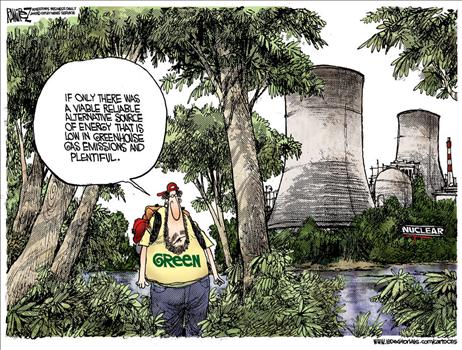
THINK CLEAN!THINK GREEN!THINK NUCLEAR!

Wednesday, October 20, 2010

Further discussion on THINK GREEN BECAUSE NUCLEAR IS GREEN!

Allright folks, previous post got many comments, which made me so motivated to write a new post on asked questions. First of all I feel quite relieved that fellow future engineers from UNITEN agreed to the fact that NUCLEAR ENERGY is clean, green and beneficial.

There was one funny question, so the answer is, if we know an alternative source is green, why we wanna go and look into how green it is compared to other green alternatives. knowing that Nuclear Energy is green is very sufficient for us.

Talking about the safety features present in NPP which is austounding, we can see that they are protected layer by layer. Look at the pictures below, you can understand the whole safety structure of it.


Courtesy of MR.Syamsul, TNB NUCLEAR UNIT

Apart from this there few factors included while designing safety measures inside a NPP. They are redundancy and diversity. Redundancy means the safety system is designed such way so that safety measures or sensors placed repetatively such that if one fails, other will sense the problem and rectify it. Diversity in the other hand means, the plant does not depend only on source of solution but many. For example, if moderator inside the reactor begin to deplete, the system can supply water from normal water supply or else from spare water tank. If any one of this fails, the other can solve the problem.

Some interesting facts:
For current existing reactors: core meltdown can occur as much as 1 incident in 10,000 years.
(assuming the if the reactor works for 10000 years)
For future reactors: core meltdown can occur as much as 1 incident in 100,000 years.
(assuming the if the reactor works for 100000 years)

Aren't this facts are mindblowing? think about it!

Well, to talk about the duration of time taken for planning till commissioning takes around 9 to 10 years. to make it simple I post the picture below, it explains what was the effort by government to initiate the nuclear energy programme. Yet folks, it is subjected to changes. Take it as a reference!


I would like add something here, looking at the picture above we know that it takes nearly a decade to operate our own NPP. Talking about a decade of time, don't you feel that we have more than enough of time to learn and acquire more skills on operating a NPP? So my point here is, we don't have worry about our people's level of expertise, we just need to put trust on them, so that they learn and train themselves well enough before they are ready to operate a Nuclear Power Plant.


some quotes by 'some' people:

All the waste in a year from a nuclear power plant can be stored under a desk.
Ronald Reagan

Almost every way we make electricity today, except for the emerging renewables and nuclear, puts out CO2. And so, what we're going to have to do at a global scale, is create a new system. And so, we need energy miracles.
Bill Gates


Tuesday, October 19, 2010

THINK GREEN BECAUSE NUCLEAR IS GREEN!

HA HI, i'm back with a new topic to discuss here. It is all about our good friend, MR.NUCLEAR!

well, there are many many and many perspective among us on nuclear energy. From a kid to elderly peoples their perspectives varies accroding to their level of understandings. But it is our team's utmost responsibility to enlighten them by providing advantages and also disadvantages to them. Then they will definitely choose the best option for the country!

Actually it reminds me a quote by Helen Keller, first deafblind person to earn a Bachelor of Arts degree and also the one who developed braille method for blind peoples. She has given a superb message to the world, the one which motivated me the most!

"I long to accomplish a great noble task, but it is my chief duty to accomplish small tasks as if they were great and noble."

In our context, our ultimate goal is to reduce global warming. It leads to adopting nuclear power plants(NPP) which doesn't emits any global warming gases. But before building any NPP, we have to learn the technology, must educate the public, send engineers to learn the technology and believe in ourselves. Hence these small (literally big) tasks must be accomplished in order to operate NPP in Malaysia.

Ok let us move on into today's topic, which is Nuclear energy is the cleanest, greenest electricity!

We can argue about this topic with various of subtopics. I would like to discuss this topic in terms of globally, economically, socially and safety. Bare with me guys, this is going to interesting.

Ok let us start to discuss, looking in terms of globally, why do we say nuclear energy is the cleanest, greenest electricity? Well, I would say and also the facts says that nuclear is clean in many terms. How about we list down them in point forms?
  • One of them would be, it doesn't emit any green house gases like carbon dioside and sulfur hexafluoride.
  • It is also clean because it doesn't occupy much area compared to hydro power plant, where massive area needed to built a damn for a hydro power plant (can see how much of habitat will be in jeopardy if we change the structure of the original surroundings)
  • NPP only consumes 3 tonnes of uranium per year, while coal powered plants uses 3 million tonnes of coal. (don't you see how much area will be used to operate for mining purposes and also the amount of energy used to transport them?
  • it is green because the fuel, uranium can be recycled (can we do that for coal based power plants?)
The basic concept of green would be sustainability of a NPP to continously generate electricity while maintaining the balance of the ecosystem. I'm very sure that nuclear power plants are clean and green. ANY DOUBTS?


ok let us look it in terms of economically. Economy = Money. Does having a NPP provides any advantage to the country? First of all, I would say that adopting nuclear technology shows that our country is also advanced technologically and Malaysians are capable of adopting and handling such technology. Do you wish to be left out in the NUCLEAR RENAISSANCE which is happening now?
By the way, having NPP has more advantages besides potraying ourselves as one of the best in the eyes of the world. The benefits are:-
  • fuel of uranium costs mush more lower than the amount that our country spents for importing fossil fuels and coals
  • operating a NPP creates various kind of job oppurtunity in the job market and at vasities, where we can offer courses related to nuclear technology
  • who knows one day, we can even develop our own type of NPP and built it around the world
Isn't it economically saves the cost of our government in purchasing fossil fuels, coals, and building damns such as BAKUN? Apart from then that, isn't there are many propects revolving adopting this amazing technology? Despite our growing demand of power, I believe we should invest in building a NPP and operating it at a lower cost. As to accomplish our vision 2020, we have to set new stragies to become an advanced country. One of them is by powering nation with Nuclear Energy!

Alright, moving into the context of socially, a NPP can bring many changes in the way of our community can think and react. It brings the awareness of saving the planet and its habitats from extinction due global warming. Besides that, we can raise to the challenge of handling new technology and also later develop it like what countries like Japan and Korea are progressing. Nuclear technology will bring healthy competition among countries to reduce the effect of global warming and also in developing nuclear technology into a new paradigm.

In fact, at other part of the world, people treat NPP as a common building; a common sight of their society. It is also will be possible as such change to occur in our country too. Pictures below are the proofs of such event.


So you must be thinking it is CLEAN and GREEN in fact. But wait, is it safe? YES IT IS!
will you adopt a technology is will harm yourself and others? will you design a power plant which is harmful to you and others. NO! NO! and NO!!!!!!
A NPP is designed in a significant way so that it has the safest systems to cater any faulty events. And it is the safest design embarked so far! This provides an oppurtunity for a NPP to stand clean and green along the environment! One with the nature!


so guys, having a NPP brings more benfits and we have seen why do others call nuclear energy CLEAN and GREEN! the time has come my friends for us to change and raise for the global challenges. One might think that they might play a part in reducing greenhouse gases by using electric vehicles. But they must understand that the electricity supply that they use to charge their electric car is not GREEN as their car. The electricity might be generated by coal or fossil fuel powered power plants. Is that GREEN my friend? THINK ABOUT IT!

THINK GREEN! THINK NUCLEAR!


GIVE NUCLEAR A CHANCE!


Sunday, October 17, 2010

"Nuke is our friend " videoclip

Hello guys, how are you doing this weekend? Hope you guys have an awesome weekend with your friends and beloved ones. Oh by the way, I should discuss a little bit about our Nuclear midterm test. It was so so so long...I've never ever taken such a long exam before. It was 4-hour test. Can you imagine? I thought I could finish it before time's up but it turned out that I did not have enough time..haha. It was not diffifult..I personally think the questions are good, comprehensive, covering everything we studied.It was just long..and I was very tired after the test. I wish we could have two tests in stead of one. Well, I think I performed ok, neither excellent nor so poor. How about u guys?
This weekend I have been doing the video about Nuclear. I want to bring something fresh and fun in the video. Not about academic things because we have been watching and listening to our excellent presentations from our beloved lecturers, Mr Shamsul and Mr Azrudi. So I don't want to present repeated things. There are a lot of meanings behind the videoclip, from the characters design, their personality to their behaviours. I hope you can find them. So, let's enjoy it.  
Please feel free to drop your comments and suggestions about the video.
Your time is very much appreciated.
Please set FULL SCREEN to enjoy it!!!
http://www.youtube.com/watch?v=FXMz_4K_M2Y

Wednesday, October 13, 2010

URANIUM AS NUCLEAR FUEL SOURCE


The fuel most widely used by nuclear plants for nuclear fission. In nuclear fission atoms are split apart to form smaller atoms, releasing energy. Nuclear power plants use the heat from nuclear fission to produce electricity.

Uranium Is Abundantly Found in Nature but Must be Processed into Fuel.


Uranium is nonrenewable, though it is a common metal found in rocks all over the world. Uranium occurs in nature in combination with small amounts of other elements.
Nuclear plants use a certain kind of uranium, U-235, as fuel because its atoms are easily split apart. Though uranium is quite common, about 100 times more common than silver, U-235 is relatively rare.
Economically recoverable uranium deposits have been discovered principally in the western United States, Australia, Canada, Africa, and South America. Once uranium is mined, the U-235 must be extracted and processed before it can be used as a fuel. Mined uranium ore typically yields one to four pounds of uranium concentrate (U3O8 or "yellowcake") per ton, or 0.05% to 0.20% U3O8.

Typical Conventional Uranium Mill

Most of Our Uranium Is Imported

Owners and operators of U.S. civilian nuclear power reactors purchased the equivalent of 53 million pounds of uranium during 2008. Uranium delivered to U.S. reactors in 2008 came from six continents:
  • 14% of delivered uranium came from the United States
  • 86% of delivered uranium was of foreign-origin:
    • 42% was from Australia and Canada
    • 33% originated in Kazakhstan, Russia and Uzbekistan
    • 11% came from Brazil, Czech Republic, Namibia, Niger, South Africa, and the United Kingdom

Enrichment

Because less than one percent of uranium ore contains uranium-235, the form used for energy production, uranium must be processed to increase the concentration of uranium-235. This process—called enrichment—increases the percentage of uranium-235 from one to five percent.

It typically takes place at a gaseous diffusion plant where the uranium hexafluoride is pumped through filters that contain very tiny holes. Because uranium-235 has three fewer neutrons and is one percent lighter than uranium-238, it moves through the holes more easily than uranium-238. This method increases the percentage of uranium-235 as the gas passes through thousands of filters.

Fuel Fabrication

The enriched uranium is taken to a fuel fabrication plant where it is prepared for the nuclear reactor. Here, the uranium is made into a solid ceramic material and formed into small barrel-shaped pellets. These ceramic fuel pellets can withstand very high temperatures, just like the ceramic tiles on the space shuttle. Fuel pellets are about the size of your fingertip, yet each one can produce as much energy as 150 gallons of oil. The pellets are sealed in 12-foot metal tubes called fuel rods. Finally, the fuel rods are bundled into groups called fuel assemblies.


Uranium Fuel Cycle:


Nuclear Reactor


The uranium fuel is now ready for use in a nuclear reactor. Fissioning takes place in the reactor core. Surrounding the core of the reactor is a shell called the reactor pressure vessel. To prevent heat or radiation leaks, the reactor core and the vessel are housed in an airtight containment building made of steel and concrete several feet thick. The reactor core houses about 200 fuel assemblies. Spaced between the fuel assemblies are movable control rods. Control rods absorb neutrons and slow down the nuclear reaction. Water also flows through the fuel assemblies and control rods to remove some of the heat from the chain reaction. The nuclear reaction generates heat energy just as burning coal or oil generates heat energy. Likewise, the heat is used to boil water into steam that turns a turbine generator to produce electricity. Afterward, the steam is condensed back into water and cooled. Some plants use a local body of water for cooling; others use a structure at the power plant called cooling towers.


Used Fuel Storage

Like most industries, nuclear power plants produce waste. One of the main concerns about nuclear power plants is not the amount of waste created, which is quite small compared to other industries, but the radioactivity of some of that waste. The fission process creates radioactive waste products. After about three cycles, these waste products build up in the fuel rods, making the chain reaction more difficult. Utility companies generally replace one-third of the fuel rods every 12 to 18 months to keep power plants in continuous operation. The fuel that is taken out of the reactor is called used fuel. The used fuel contains both radioactive waste products and unused fuel. The used fuel is usually stored near the reactor in a deep pool of water called the used fuel pool. The used fuel cools and loses most of its radioactivity through radioactive decay. In three months, the used fuel will lose 50 percent of its radiation; in one year, 80 percent; in 10 years, 90 percent. The used fuel pool was intended as a temporary method for storing used nuclear fuel.

However, there is no permanent storage solution yet for used nuclear fuel, and fuel pools space is running out. The nuclear industry has designed dry cask storage as another temporary solution. Now, the used fuel stays in the pool for five to seven years. Then, it is moved elsewhere on the nuclear power plant site to be stored in vaults or dry casks. Each of these methods for managing used nuclear fuel puts the fuel into airtight, steel and concrete structures. The U.S. Nuclear Regulatory Commission has stated that it is safe to store used fuel on site for at least 120 years. Eventually, the used fuel will be reprocessed and/or transported to a permanent federal disposal site.

Image of an used fuel storage pool


Reprocessing
Used fuel contains both radioactive waste products and unused nuclear fuel. In fact, about one-third of the nuclear fuel remains unused when the fuel rod must be replaced. Reprocessing separates the unused nuclear fuel from the waste products so that it can be used in a reactor again.Currently, American nuclear power plants store the used fuel in used fuel pools—without reprocessing. Reprocessing is more expensive than making new fuel from uranium ore. If uranium prices rise significantly or storage becomes a bigger problem, reprocessing may gain favor.